Energy Implications of Language and Runtime Choices in Data Ingestion Pipelines
Yuvraj Singh Pathania, Viktor Seršiḱ, Emils Dzintars, Madhav Chawla.
Group 8.
Compare the energy consumption of Python, Java, Go, and Rust when performing a data ingestion task.
Introduction
Energy consumption is becoming an important concern in software engineering, yet developers rarely have concrete guidance on how implementation choices influence energy efficiency. In this study, we investigate how programming language selection affects energy usage in a common data-intensive workload. We design and implement an identical data ingestion pipeline that reads large JSONL datasets, performs schema validation and lightweight transformations, aggregates records, and writes the results to Parquet format. The pipeline is implemented across multiple languages representing different runtime and compilation models, namely Python, Go, Java, and Rust.
Using EnergiBridge, we systematically measure execution time, energy consumption, and resource utilization under controlled experimental conditions. By analyzing both total energy usage and average power draw, we examine whether observed differences are primarily driven by runtime performance or by variations in power behavior. Our results provide practical insights into the energy-performance trade-offs of language and runtime choices for data processing systems. We further provide a replication package containing implementations, automation scripts, and measurement procedures to support reproducibility and future comparative studies.
Why compare language energy for ingestion pipelines?
Data ingestion is a “hidden” but ubiquitous workload: ETL jobs, observability pipelines, log processing, feature generation, and data lake compaction. The same pipeline can be implemented in many languages, and the choice often comes down to ecosystem or developer experience. However, ingestion is also compute- and IO-intensive, so small differences in runtime behavior (parsing, allocations, GC, compression libraries, Parquet writers) can translate into non-trivial energy differences at scale.
This project investigates a focused question:
- RQ: For the same ingestion pipeline and the same dataset slice, how do Python, Go, Java, and Rust differ in energy consumption, execution time, and power behavior?
Our goal is not to declare a universal “winner”, but to provide actionable intuition: are the differences mainly about doing the work faster (lower time), or about drawing less power while doing it?
Workload definition (same task across languages)
All four implementations perform the same high-level pipeline:
JSONL(.gz) → validate → transform → aggregate → Parquet + checksum
For each JSON record we:
- Validate (strict) required fields:
id,type,repo.id,created_at - Transform: normalize
typeto lowercase; deriveevent_day = YYYY-MM-DDfromcreated_at - Aggregate by
(event_day, event_type):record_countsum_repo_id
- Write the aggregate table as Parquet (fixed schema/column order) and emit a deterministic checksum over sorted rows.
Dataset slice
- Dataset: GH Archive events, hourly
.json.gz - Date: 2026-02-19
- Hours: 1
- Mode: cpu (strict validation enabled)
- Input strategy: auto-download inside each language using the hardcoded
download_date+download_hours.
The single-hour slice is small enough to run many repetitions, while still being representative of messy real-world JSON lines with nested fields.
Implementations
We implemented the same pipeline in four languages:
- Python: CPython, JSON parsing via stdlib
json, Parquet output viapyarrow. - Go: stdlib JSON + Parquet writer library (with ZSTD compression enabled).
- Rust:
serde_json+ Arrow/Parquet writer stack. - Java: OpenJDK + Jackson + Parquet libraries via Maven.
All implementations download from the same GH Archive endpoint and write outputs into a shared data/ directory when run under Docker.
Measurement methodology
What we measured
Per run, we report:
- Energy (J): CPU package energy ($E_{pkg}$) derived from the
PACKAGE_ENERGY (J)counter (intel cpu, linux mint). - Time (s): wall-clock runtime of the benchmark command.
- Average power (W): $P_{avg} = E_{pkg} / T$
- Energy–Delay Product (EDP): $EDP = E_{pkg} \times T$ (lower is better if you care about both energy and latency)
What we did not measure (and why it matters)
It is important to distinguish where energy is being measured:
- We did not measure whole-system wall power (e.g., from a plug-level meter). That would include SSD, networking, fans, display, and PSU losses.
- Instead, we used CPU package energy (RAPL domain), which is often the best-available repeatable signal for CPU-bound workloads, but it is not the full-machine footprint.
This distinction matters most when the workload is IO-heavy (storage/network dominated). In our experiment we deliberately used cpu/strict validation to keep the workload more compute-heavy and make package energy a meaningful proxy.
Tooling
We used EnergiBridge (invoked as energibridge) to sample energy counters at a high frequency and output time-series CSV files. Each per-run CSV contains cumulative energy readings; we compute per-run energy as:
We also compute per-run time from the same CSV:
\[T_{run} = (t_{last} - t_{first}) / 1000\]where timestamps are in milliseconds.
Protocol
- Warmups: 1 per language
- Measured runs: 20 per language (80 total)
- Sampling interval: 200 µs
- Run order: in each measured round, the language order is randomized (fixed seed for repeatability).
Environment notes
The recorded CSVs include energy counters like PACKAGE_ENERGY (J) and DRAM_ENERGY (J), which typically come from Intel RAPL domains. We report package energy, which is closer to “CPU + uncore” energy than whole-system energy (i.e., it does not include everything the PSU would see).
From the measurement CSV metadata, the system had 8 logical CPUs (per-core frequency/utilization columns) and ~33.36 GB total memory (reported as TOTAL_MEMORY=33360306176 bytes).
Results
Summary table (package energy)
Below we summarize mean ± 95% CI across 20 measured runs per language:
| Language | Mean energy (J) | Mean time (s) | Mean power (W) | Mean EDP (J·s) |
|---|---|---|---|---|
| Rust | 58.69 ± 1.86 | 3.692 ± 0.048 | 15.90 ± 1.03 | 216.83 ± 17.50 |
| Python | 62.42 ± 2.23 | 3.902 ± 0.064 | 16.00 ± 1.15 | 243.77 ± 23.43 |
| Go | 101.86 ± 3.46 | 8.574 ± 0.200 | 11.94 ± 1.36 | 871.10 ± 42.41 |
| Java | 114.94 ± 1.73 | 5.883 ± 0.056 | 19.54 ± 0.70 | 676.24 ± 27.35 |
Ranking by mean energy (lower is better): Rust < Python « Go < Java.
Relative differences (practical effect size)
Sometimes “statistically different” is less important than “how big is the difference in practice?”. Using Rust as the lowest-energy baseline:
- Python used ~6.3% more package energy than Rust on average.
- Go used ~73.5% more package energy than Rust on average.
- Java used ~95.8% more package energy than Rust on average.
Even with just a one-hour slice, these gaps are large enough to matter if this pipeline is executed frequently (e.g., hourly ingestion jobs across many datasets).
Stability across repetitions
Energy and time naturally vary due to OS scheduling, background load, and thermal state. Across 20 runs we observed:
- Energy coefficient of variation (CV) around 6–8% for Rust/Python/Go, and ~3.2% for Java.
- Time CV around 2–5%.
This is one reason we ran 20 measured repetitions and randomized run order: it makes the averages more robust to run-to-run noise.
Visualizations
Mean energy with 95% CI:
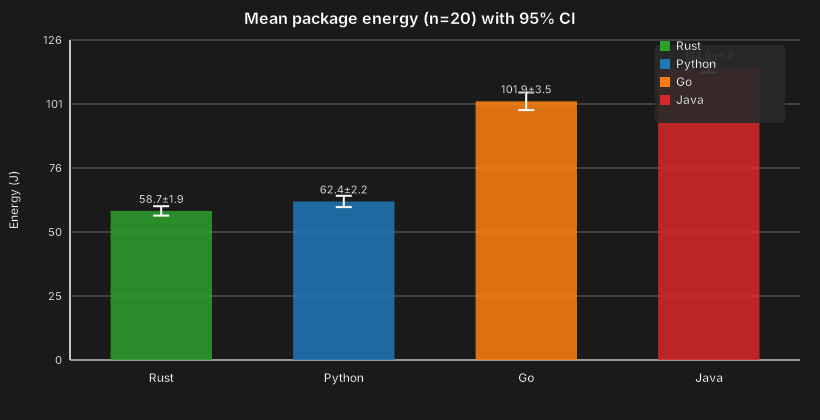
This bar chart shows the mean package energy per language with 95% confidence intervals. The error bars represent the uncertainty in our mean estimates based on 20 measured runs per language. Rust and Python cluster together at the low end (~58–62 J), while Go and Java show substantially higher mean energy consumption.
Energy vs time per run (each dot is one measured run):
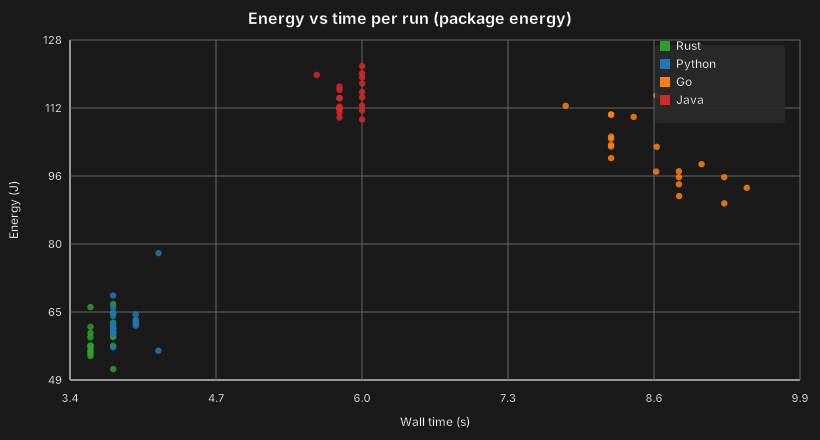
This scatter plot shows the relationship between execution time and package energy for each individual measured run. Points in the lower-left quadrant represent the most efficient runs (low energy, low time). The clustering pattern reveals that:
- Rust and Python runs cluster tightly in the low-energy, low-time region.
- Go runs spread horizontally (longer times, moderate energy).
- Java runs cluster at higher energy levels despite moderate execution times.
Energy distribution (violin plot):
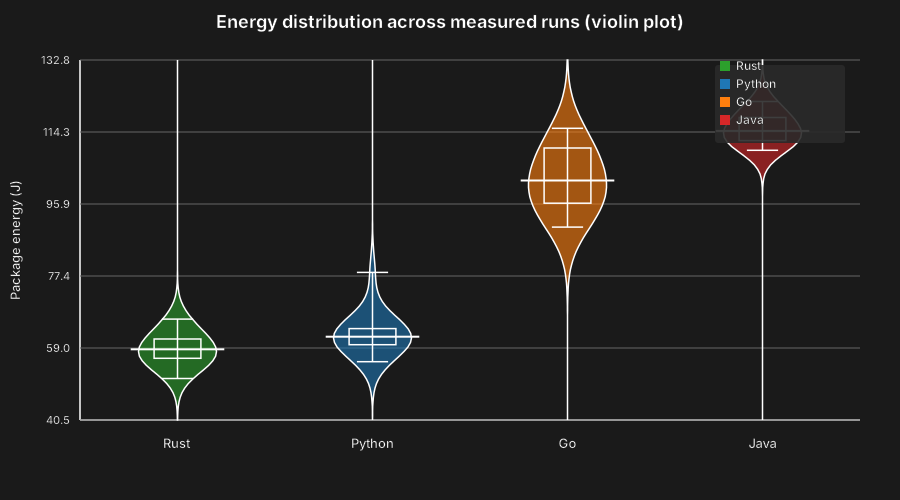
Violin plots combine the information of a box plot (median, quartiles, whiskers) with a kernel density estimate showing the full distribution shape of energy values across all 20 measured runs per language. The width of each “violin” at any energy level indicates how many runs had values near that level—wider sections mean more runs clustered there.
Key insights from the energy violin plot:
- Rust and Python show narrow, symmetric distributions centered around ~58–62 J, indicating consistent, predictable energy consumption across runs.
- Go shows a wider distribution with a longer tail toward higher energy values, suggesting more variability in its energy behavior.
- Java shows a relatively narrow but shifted distribution centered around ~115 J, indicating consistent but consistently higher energy consumption.
The median line (thick horizontal line) shows the central tendency, while the quartile box shows where 50% of runs fall. The whiskers extend to the full range of observed values.
Time distribution (violin plot):
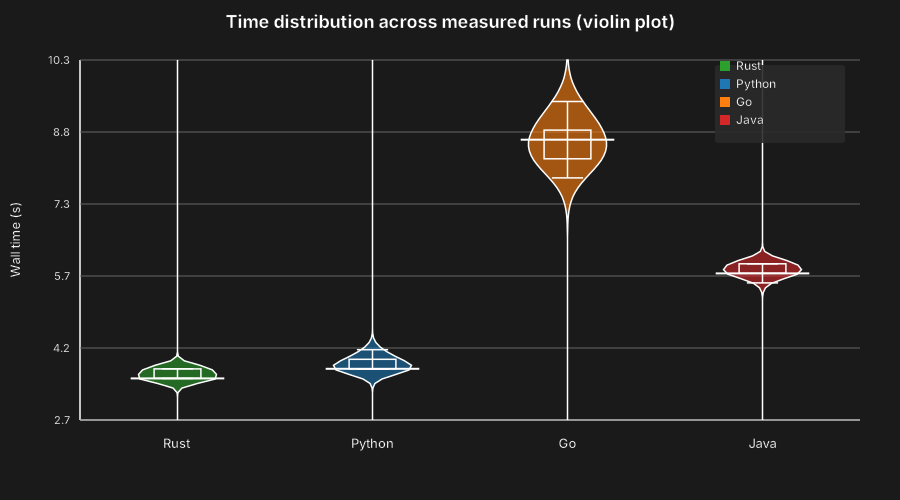
The time violin plot reveals the distribution of execution times across measured runs. This complements the energy analysis by showing whether time variability contributes to energy differences.
Observations:
- Rust shows the tightest time distribution (~3.6–3.8s), indicating very consistent performance.
- Python has a slightly wider distribution but still centered around ~3.9s.
- Go shows the widest time distribution (~8.2–9.0s), with substantial variability that contributes to its higher energy consumption.
- Java shows moderate time variability (~5.8–6.0s) but runs at consistently higher power, explaining why it consumes more energy despite being faster than Go.
The violin plots help us understand that variability matters: even if two languages have similar mean energy, differences in distribution shape (symmetry, tails, clustering) can affect real-world predictability and worst-case behavior.
Discussion: where do the differences come from?
1) Fast can be energy efficient (but not always)
Rust and Python finish the workload in ~3.7–3.9 seconds on average and also show the lowest package energy. This suggests the dominant driver here is time-to-complete: finishing earlier reduces the time the CPU package stays in a high-activity state.
However, Java is an instructive counterexample: it completes faster than Go (5.9s vs 8.6s) but still consumes more package energy (114.9J vs 101.9J). The scatter plot shows Java points at higher power and moderate time: Java tends to “go harder” (higher average W), whereas Go tends to run longer at lower average W.
2) Power behavior differs significantly by runtime
The mean power numbers show two clusters:
- High-power cluster: Java (~19.5W), Python/Rust (~15.9–16.0W)
- Lower-power cluster: Go (~11.9W)
So Go’s energy is not high because it draws high power; it’s high because it runs longer. Java’s energy is high because even though it’s not the slowest, it runs at higher power.
3) EDP favors Rust/Python strongly
If your decision metric is “save energy and finish quickly” (e.g., latency-sensitive pipelines), EDP highlights the same story:
- Rust is best (lowest EDP).
- Python is close behind.
- Java and Go are much worse due to either high power (Java) or long runtime (Go).
4) Likely causes (hypotheses)
We did not instrument the pipeline into fine-grained phases in this iteration, but based on typical ingestion behavior we expect:
- JSON parsing and validation to dominate CPU time in strict mode. Languages with faster parsing and fewer allocations can reduce both runtime and CPU energy.
- Memory management strategy to matter:
- Java’s GC and JIT compilation can improve steady-state throughput but may increase instantaneous power draw.
- Rust’s ahead-of-time compilation and explicit memory ownership can reduce runtime overhead at the cost of more complex code.
- Python’s interpreter overhead often makes it slower on CPU-bound tasks, but in this specific workload the Parquet writer and I/O patterns may dominate, allowing Python to remain competitive.
- Parquet + compression libraries to influence both time and energy. Different default buffer sizes, compression implementations, and vectorization can change CPU utilization significantly.
5) Connecting the hypotheses to our observed ranking (Rust ≈ Python « Go < Java)
Rust: lowest energy and lowest EDP
Rust’s result is consistent with a typical ingestion profile for an AOT-compiled language:
- Low runtime overhead: no interpreter and no GC pauses; tight loops over decoded JSON lines can be efficient.
- Predictable memory behavior: fewer hidden allocations and a lower-level control of buffers can reduce CPU work per record.
- Good “throughput per watt”: Rust’s average power is similar to Python (~15–16W), but it finishes slightly faster, which reduces energy.
Even if some of the benefit comes from library implementation quality (e.g., Arrow/Parquet writer), the practitioner takeaway remains: in this pipeline, Rust delivered the best combined energy+latency outcome.
Python: surprisingly close to Rust (but with caveats)
In many CPU-bound tasks, Python is slower due to interpreter overhead. Our results show Python close to Rust in both energy and time, which suggests the workload may not be “pure Python execution” dominated:
- Native extensions matter: Parquet writing via
pyarrowruns largely in optimized native code. If a non-trivial fraction of total time is spent in the Arrow/Parquet layer, Python’s interpreter overhead becomes less dominant. - Validation cost is limited: our strict validation checks a small set of fields and simple string patterns. If the bottleneck is I/O + decompression + Arrow serialization rather than Python-level branching, Python can remain competitive.
However, this closeness should not be over-generalized: a pipeline with heavier per-record transformations (e.g., complex schema normalization, joins, enrichment) would likely magnify Python’s interpreter overhead and shift the ranking.
Go: lower power, but much longer runtime
Go stands out as the lowest average power (~11.9W) but second-worst energy because it runs much longer:
- Longer runtime dominates energy: even with lower power, total energy accumulates over time ($E \approx P \times T$).
- Potential sources of longer runtime:
- JSON decoding in Go can allocate heavily unless carefully optimized (e.g., using streaming decoders, reuse buffers).
- The Parquet writing stack and compression settings can be a bottleneck depending on library and row-group/buffer defaults.
- GC and allocation patterns: Go’s GC is efficient, but allocation-heavy parsing can still increase CPU work and extend runtime.
This is a concrete example of why “lower average watts” does not automatically imply “lower energy” for batch jobs.
Java: not the slowest, but the highest energy (power-heavy execution)
Java uses the most energy despite completing faster than Go. The reason is visible in the power figures: Java draws the highest average power (~19.5W). Likely contributing factors include:
- JIT compilation and warmup: even with one warmup run, JIT activity can still influence measured runs (depending on code paths and JVM tiering), sometimes raising CPU utilization and power.
- Aggressive optimization → aggressive CPU usage: Java often achieves good throughput by using the CPU more aggressively (higher frequency, more sustained utilization), which can increase average package power.
- GC + allocation behavior: if the JSON + aggregation path allocates heavily, GC activity can add overhead and raise power.
In other words, Java may be “fast” in a wall-clock sense while still being “expensive” in energy because it keeps the package in a higher power state for most of the run.
Cross-cutting factor: ecosystem/libraries are part of the reality
Even if all four implementations follow the same logical pipeline, the actual work performed differs subtly via:
- parsing strategies and defaults,
- compression implementations and tuning,
- Parquet writer row-group sizing,
- buffering and I/O patterns.
From an engineering standpoint, this is not a bug in the comparison—it reflects real decisions teams make. But it does mean our results should be interpreted as language + typical ecosystem for this ingestion task, not “language runtime in isolation”.
Threats to validity (what could bias these results?)
- Package vs whole-system energy: we used CPU package energy (RAPL domain). Whole-system energy (including RAM, SSD, network, fans, and PSU losses) may change the absolute values and potentially the ranking for IO-heavy workloads.
- Single dataset slice: results are for one hour on one date. Another hour/day may differ in event mix and record count.
- Implementation differences: even with a “fairness contract”, language ecosystems differ (JSON parsing, Parquet writer implementation, compression defaults). These are real differences a practitioner experiences, but they also mean the comparison is not purely “language runtime” in isolation.
- Containerization: running under Docker adds some overhead. We used the same container approach for all languages to keep conditions comparable.
- Hardware and OS configuration: CPU governor, background load, thermal state, and power limits can shift both time and energy. We mitigate this by using 20 repetitions and randomized run order.
Reproducibility checklist (what to report in your own replication)
If you replicate or extend our experiment, we recommend recording:
- Hardware: CPU model, number of cores/threads, RAM size, storage type.
- OS: distribution + kernel version.
- Tool versions: EnergiBridge commit/version; Docker version; language runtimes (Python/Go/Rust/Java).
- Exact dataset slice: GH Archive date/hour list and whether files were already cached.
- Run parameters: warmups, measured runs, sampling interval, and run order randomization seed.
Replication package
We provide a replication package with Dockerfiles, scripts, and the measurement outputs used in this report:
- Repository: Programming-Language-Data-Ingestion-Comparison
- Branch used for this report:
python-test - Raw measurement data: The per-run EnergiBridge CSV files (80 measured + 4 warmup) are available in the
data2/out/energibridge_runs_all_languages/directory of thepython-testbranch.
At a high level, you can reproduce the measurement matrix by:
- building the four Docker images, and
- running the cross-language EnergiBridge script (which creates per-run CSVs and a summary report).
Minimal reproduction steps
From the repo root:
- build and run the dockerized benchmark once for sanity (any language), then
- run the cross-language EnergiBridge script (warmup + measured runs).
To ensure you use the same dataset slice as this report, set the hardcoded download date in each language to:
- 2026-02-19, hours=1, mode=cpu (strict validation)
Conclusion
For a strict-validation ingestion pipeline on a one-hour GH Archive slice (2026-02-19), we observed large differences in package energy across languages:
- Rust and Python were both fast and energy-efficient in our setup.
- Go tended to use less power but ran much longer, resulting in higher energy.
- Java ran at higher average power and ended up consuming the most package energy despite being faster than Go.
The practical takeaway is that language choice affects both how quickly the pipeline finishes and how much power it draws while doing so. For teams operating large-scale ingestion workloads, these differences can compound, making language/runtime decisions relevant not only for performance but also for energy and sustainability goals.
Back to all projects